WiserBuild Is Back: A Wildfire Plan Review for California Homes Before You Build
September 29, 2026 · 9 min read
WiserBuild Is Back, Rebuilt
WiserBuild is back, rebuilt from the ground up. It's a plan review for homes in wildfire-prone California: you upload your building plans, and we check them against California's wildfire construction rules and the features insurers look at, before construction starts.
It's for homeowners planning a new home or a renovation, builders and architects designing in fire country, and families rebuilding after a fire. Reviews are free right now, and most reports arrive within two to three business days.
Here's how it works today:
- Upload your plans. The secure form on wiserbuild.com takes PDFs, CAD files (.dwg or .dxf), and images (JPG, PNG, or WebP), up to 50 MB per file, plus your email address.
- We review them. Our team goes through your plans for wildfire readiness and the factors insurers weigh.
- You get a personalized report. It highlights the features that already work, the risks worth addressing, and our recommendations.
WiserBuild reviews single-family homes, additions, and small multifamily projects. Larger or commercial projects may need a custom review. Your plans stay within AACI Group, WiserBuild's parent company, and are encrypted in storage and in transit.
Why Review Plans Before You Build
The choices that matter most in a wildfire get made on paper: the roof covering, the vents, how the eaves are closed off, the siding, the windows, the deck, and the first five feet around the house. Once those are framed, sheathed, and inspected, changing them means tearing out finished work. Changing a line on a drawing costs far less.
Those details matter because of how homes catch fire. The National Institute of Standards and Technology (NIST) states that "embers are responsible for the majority of structure losses" in fires where homes meet wildland. Embers get in through open vents, gaps at eaves and garage doors, and anything combustible touching the house.
Building to a higher standard from the start is also more affordable than many people expect. A 2022 study by Headwaters Economics, produced in partnership with the Insurance Institute for Business & Home Safety (IBHS), estimated that wildfire-resistant construction adds approximately 2 to 13 percent to the cost of a new California home, depending on the level of protection chosen.
What a WiserBuild Review Checks
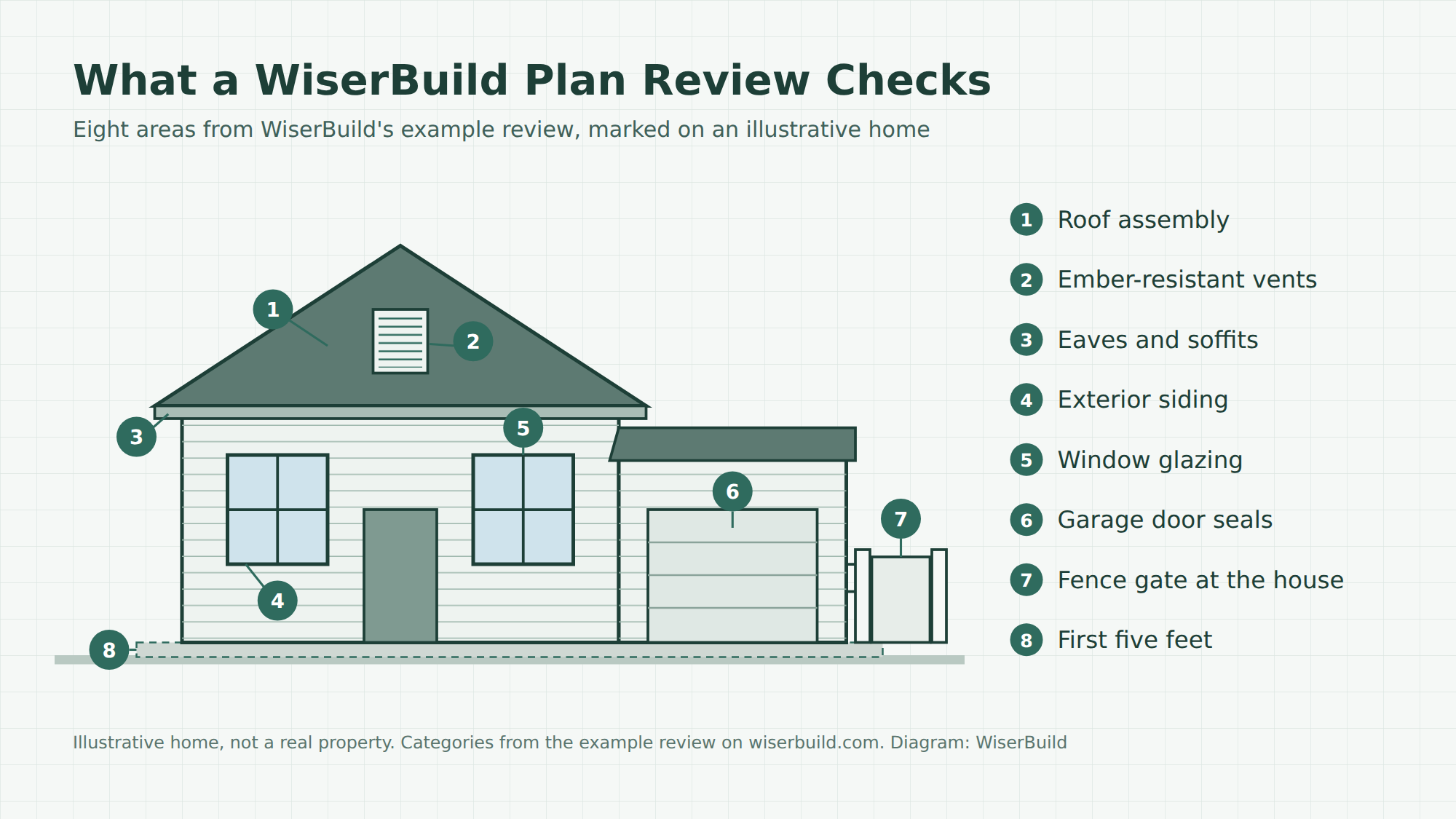
The example review on our site marks up eight areas, grouped here by where they sit on the house.
Where Embers Get In
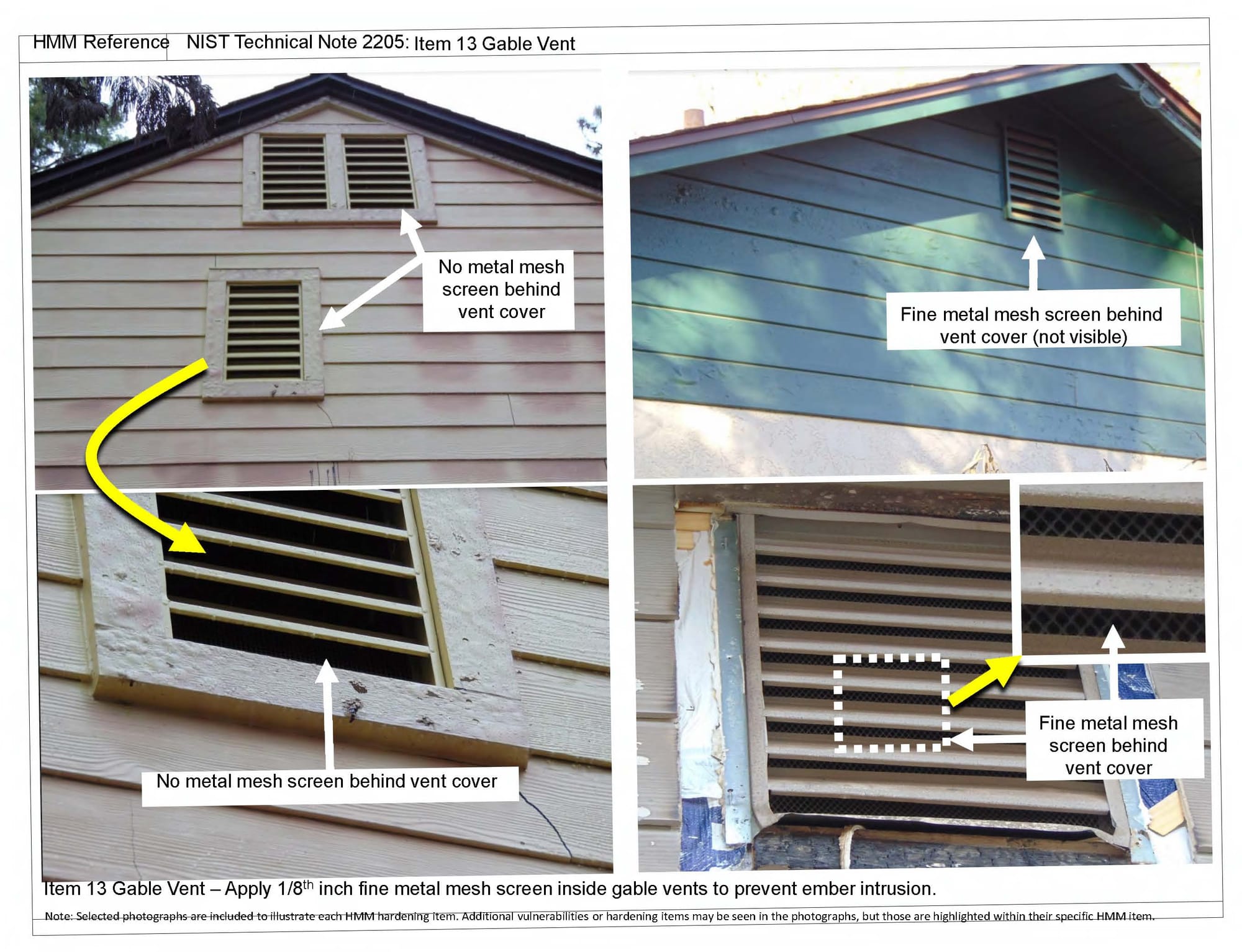
- Ember-resistant vents. Do the vent specifications call for ember-resistant designs and listed materials?
- Eaves and soffits. Are the eaves enclosed, and are openings protected?
- Garage door seals. Do the door edges leave gaps where wind-driven embers could enter?
The Shell of the House
- Roof assembly. Do the plans specify a Class A roof covering and enclosed gaps at the roof edges?
- Exterior siding. Does the siding material reduce exposed combustible surfaces?
- Window glazing. Are exterior windows dual-pane with tempered glass where they face exposed areas?
Right Next to the House
- The first five feet. Does the site plan keep the area immediately around the home low in combustible material?
- Fence gates. Does a fence or gate that attaches to the house use a material that could carry fire to the wall? In our example, a vinyl gate got flagged.
The Rules behind the Review
Three sets of rules shape a WiserBuild review. Here's what each covers and where each stands as of September 29, 2026.
Building Code: Chapter 7A, R337, and the New Wildland-Urban Interface Code
For years, California's wildfire construction standards lived in California Building Code Chapter 7A, "Materials and Construction Methods for Exterior Wildfire Exposure," and in the matching California Residential Code Section R337 for homes. They set requirements for roofs, vents, eaves, exterior walls, windows, doors, and decks in designated fire hazard areas.
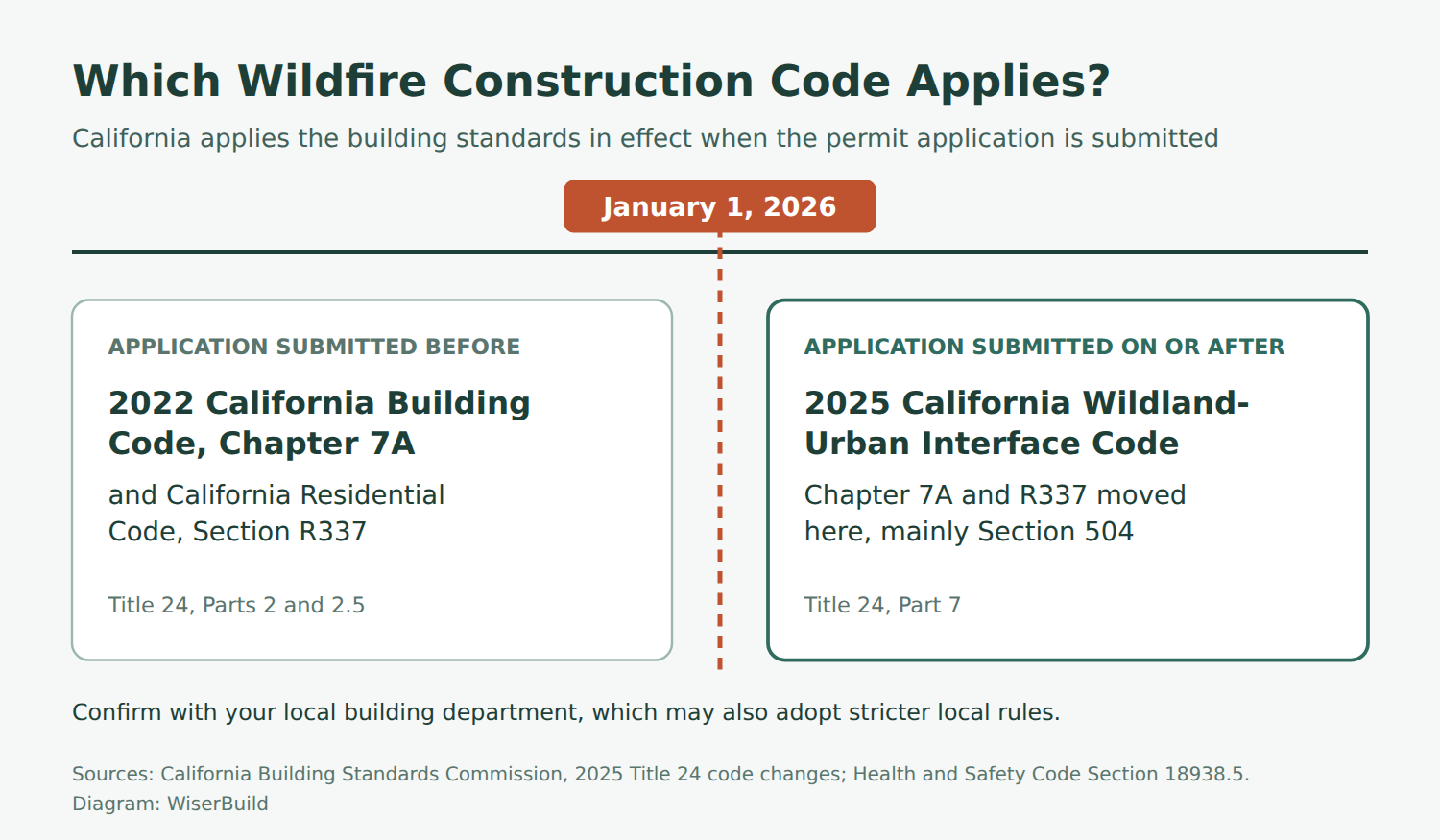
The 2025 code cycle, effective January 1, 2026, moved those requirements into a new standalone code: the California Wildland-Urban Interface Code, Title 24, Part 7. The California Building Standards Commission says it deleted Chapter 7A from the Building Code and repealed Residential Code Section R337, relocating both into the new code. The construction details now sit mainly in its Section 504.
Which edition applies depends on timing. Under Health and Safety Code Section 18938.5, the standards in effect when you submit your permit application are the ones that apply. Your local building department confirms which edition governs your project and may add stricter local rules.
Insurance: 10 CCR 2644.9, Safer from Wildfires
The California Department of Insurance's Safer from Wildfires regulation, California Code of Regulations, Title 10, Section 2644.9, took effect October 14, 2022. It bars insurers from using a rating plan that doesn't "take into account and reflect" these mitigation factors:
- Community: a Firewise USA site in good standing, or a designated Fire Risk Reduction Community.
- Around the home: clearing vegetation and debris from under decks; clearing vegetation, debris, mulch, and stored combustibles within five feet of the home; using only noncombustible materials within five feet, including fences and gates; no combustible sheds or outbuildings within 30 feet; and complying with defensible space laws.
- Building hardening: a Class A fire-rated roof, enclosed eaves, fire-resistant vents, multipane windows or functional shutters, and at least six inches of noncombustible vertical clearance at the bottom of exterior walls.
Several of these line up with what a WiserBuild review checks: the roof, eaves, vents, windows, fence gates, and first five feet.
Defensible Space: Public Resources Code 4291 and Zone 0
Public Resources Code Section 4291 requires defensible space of up to 100 feet around homes in and near California's wildlands, but not beyond the property line. AB 3074, signed in 2020, added an ember-resistant zone within five feet of the home, often called Zone 0, to be defined by regulations from the Board of Forestry and Fire Protection.
Here's where Zone 0 stands:
- The Board adopted Zone 0 regulations in August 2026, and they went to the Office of Administrative Law (OAL) for review.
- OAL lists that package, file 2026-0828-03E, as withdrawn on September 8, 2026.
- The Board says it continues to work with OAL on final review.
So the statewide Zone 0 rule is pending, not law. Once it takes effect for new construction, Section 4291 gives existing homes three more years to comply. Executive Order N-18-25 had directed the Board to finish the rulemaking by December 31, 2025.
Who Reviews Your Plans
Plans are reviewed with input from AACI's insurance team of licensed agents, underwriters, and former actuaries. Your report reads your plans the way insurance professionals read a property, alongside the wildfire construction rules above.
How to Read Your Results
Your report sorts what we found into a few groups:
- Strengths: features that already hold up well. Keep them in the final construction set so they don't get swapped out later to save money.
- Worth a closer look: items to fix or confirm, such as a vent specification that doesn't name an ember-resistant product.
- Recommendations: specific changes to take to your architect, designer, or builder before you submit for a permit.
Keep the report with your project documents. After construction, photos and product details for your roof, vents, and windows can help when you talk with an insurance agent about your home.
What a Review Is Not
A WiserBuild review is informational. It doesn't replace your building department's plan check or permit, and it isn't an approval of any kind. It isn't a guarantee that your home will survive a wildfire or that you'll get any particular coverage, price, or other insurance outcome. WiserBuild doesn't sell, quote, or bind insurance; insurers make coverage and pricing decisions. For engineering, architectural, or legal questions, work with licensed professionals.
Rebuilding after a Fire
The January 2025 fires in Los Angeles County left thousands of families facing a rebuild. CAL FIRE reports 6,845 structures destroyed in the Palisades Fire and 9,419 in the Eaton Fire.
Many of those families are designing and permitting while the rules shift under them. The building code changed on January 1, 2026, so the date a permit application went in decides which wildfire standards apply. The statewide Zone 0 rule is still pending. A review before you submit helps you catch gaps while they're still lines on a drawing.
A rebuild is also a chance to go past the minimum. Choices like noncombustible fencing where it meets the house, enclosed eaves, and a clear first five feet cost the least when they're part of the original design.
What We're Building Toward
WiserBuild is part of Loss Prevention Solutions at AACI Group. Our goal is to gather the evidence that shows carriers mitigation lowers wildfire risk, and to make the case that lower risk should mean better insurability and lower premiums. We're working toward that; it isn't proven yet.
What's already in place is the regulation: California requires insurers to recognize qualifying mitigation measures in their rating plans. Building to wildfire-resistant standards can improve your insurability. It can't guarantee it.
Start Your Plan Review
Start your free WiserBuild plan review. Upload your plans and get your report in two to three business days.
Check your coverage. Five Bays Insurance Agency, AACI Group's licensed insurance agency (California license 6016871), can review your coverage and talk through how mitigation may affect your insurability. Five Bays serves California homeowners.
Sources
- National Institute of Standards and Technology. "How Fire Spreads in the WUI." Updated September 11, 2023. https://www.nist.gov/el/fire/resources/hazard-mitigation-methodology-hmm/how-fire-spreads-wui
- Headwaters Economics, in partnership with the Insurance Institute for Business & Home Safety. "Construction Costs for a Wildfire-Resistant Home: California Edition." July 27, 2022. https://headwaterseconomics.org/natural-hazards/wildfire-resistant-costs-california/
- National Institute of Standards and Technology. "HMM Item Vents: Gable Vent," from Hardening Actions: Construction Guidance (Technical Note 2205). August 22, 2023. https://www.nist.gov/image/hmm-item-vents-gable-vent
- International Code Council. 2022 California Building Code, Chapter 7A, "Materials and Construction Methods for Exterior Wildfire Exposure." Accessed September 29, 2026. https://codes.iccsafe.org/content/CABC2022P1/chapter-7a-sfm-materials-and-construction-methods-for-exterior-wildfire-exposure
- International Code Council. 2022 California Residential Code, Section R337. Accessed September 29, 2026. https://codes.iccsafe.org/s/CARC2022P3/chapter-3-building-planning/CARC2022P3-Pt03-Ch03-SecR337
- International Code Council. 2025 California Wildland-Urban Interface Code, Chapter 5, "Special Building Construction Regulations." Effective January 1, 2026. https://codes.iccsafe.org/content/CAWUIC2025P1/chapter-5-special-building-construction-regulations
- California Building Standards Commission. "2025 Title 24 California Code Changes." Accessed September 29, 2026. https://www.dgs.ca.gov/BSC/Resources/2025-Title-24-California-Code-Changes
- City of Los Angeles Department of Building and Safety. "Fire Hazard Severity Zone Supplemental Checklist," PC/STR/Corr.Lst.116. Effective January 1, 2026; revised March 27, 2026. https://dbs.lacity.gov/sites/default/files/efs/forms/pc17/PC.STR.Corr.Lst.116_2026_Supplemental_FHSZ_Rev_2025-12-23.pdf
- California Legislature. Health and Safety Code Section 18938.5. Accessed September 29, 2026. https://leginfo.legislature.ca.gov/faces/codes_displaySection.xhtml?lawCode=HSC§ionNum=18938.5
- California Department of Insurance. "Safer from Wildfires." Accessed September 29, 2026. https://www.insurance.ca.gov/01-consumers/200-wrr/Safer-from-Wildfires.cfm
- California Code of Regulations, Title 10, Section 2644.9, "Consideration of Mitigation Factors; Wildfire Risk Models." Filed and operative October 14, 2022. Text via Cornell Legal Information Institute. https://www.law.cornell.edu/regulations/california/10-CCR-2644.9
- California Legislature. Public Resources Code Section 4291, as amended by Stats. 2025, Ch. 731 (AB 1455). Effective October 13, 2025. https://leginfo.legislature.ca.gov/faces/codes_displaySection.xhtml?lawCode=PRC§ionNum=4291
- California Legislature. AB 3074, Chapter 259, Statutes of 2020. September 29, 2020. https://leginfo.legislature.ca.gov/faces/billTextClient.xhtml?bill_id=201920200AB3074
- California Office of Administrative Law. "Recent Actions Taken on Emergency Regulations," file 2026-0828-03E, "Zone 0 Defensible Space." Withdrawn September 8, 2026. https://oal.ca.gov/emergency_regulations/recent_actions_taken_on_emergency_regulations/
- California Board of Forestry and Fire Protection. "Defensible Space Zones 0, 1, and 2." Accessed September 29, 2026. https://bof.fire.ca.gov/projects-and-programs/defensible-space-zones-0-1-and-2
- Office of the Governor of California. Executive Order N-18-25. February 6, 2025. https://www.gov.ca.gov/wp-content/uploads/2025/02/2025-2-6.Urban-Conflagration-EO-ATTESTED.pdf
- CAL FIRE. "Palisades Fire." Updated April 9, 2026. https://www.fire.ca.gov/incidents/2025/1/7/palisades-fire
- CAL FIRE. "Eaton Fire." Updated August 6, 2026. https://www.fire.ca.gov/incidents/2025/1/7/eaton-fire